

Your monthly budget in Honolulu.
Honolulu rent, GET tax and tourism-season pay make budgeting tight. Monthly shows your real free money after fixed bills. Manual entry, no bank link needed.
$0
Cost to use Monthly
At your pace
Start with your first entries
0
Bank accounts connected
100%
Your data stays yours
Sound familiar?
Bring your expenses in Honolulu together and get a clearer view of the month.
Without Monthly
- You don't know your real free money until you've already spent it
- Fixed expenses catch you off guard every month even though they're always the same
- You reach the weekend without knowing if you can go out without overspending
- Your savings and investments are scattered across different places with no unified view
- Spreadsheets are a pain and banking apps mix everything together with no structure
With Monthly
- You see your real free money from day one of the month, before you spend a dollar
- You enter all your fixed expenses once and Monthly carries them into every new month
- The weekend reserve is already set aside before the week even starts
- All your investments logged in one place, no APIs or complications
- Your monthly budget in one app you can use from your phone
Everything you need to plan your month in Honolulu
Monthly covers every part of your monthly finances, without the complications.
Paycheck and real free money
Enter your paycheck in Honolulu and Monthly instantly calculates how much free money is left after every commitment for the month.
Fixed expenses under control
Rent, utilities, card payments and subscriptions in Honolulu organized in one place. No surprises at the end of the month.
Weekend reserve
Set aside money for going out before you spend it. Four weekends, four reserves. Never reach Sunday wondering where it all went.
Investments and savings
Log your savings, retirement account, brokerage holdings or anything else. No APIs or live prices. Just your own numbers, always at hand.
Money owed to you
Lent money to someone? Log it in Monthly. Nothing forgotten, nobody made to feel awkward about asking for it back.
Optional AI assistant
Ask about your records and review your budget with the assistant. You choose whether to enable it and which decisions to make.
How to organize your month in Honolulu with Monthly
Start with your income and fill in your plan at your own pace.
Enter your paycheck
The starting point. Your take-home pay for the month, entered in seconds at the start of each period.
Add fixed expenses
Rent, utilities and card payments in Honolulu. Everything you already know is coming, in one place.
Set the weekend reserve
Decide how much you want available each weekend and Monthly sets it aside automatically from the plan.
Log investments and debts
Savings, retirement accounts, brokerage holdings, whatever applies. All noted down without relying on live prices.
See your real free money
The number that matters: how much you can spend without touching the rest of the month. No surprises, no guilt.
How to organize your month in Honolulu without constantly putting out fires
A concrete guide to lowering financial anxiety and gaining clarity with your paycheck, fixed expenses, reserves and investments.
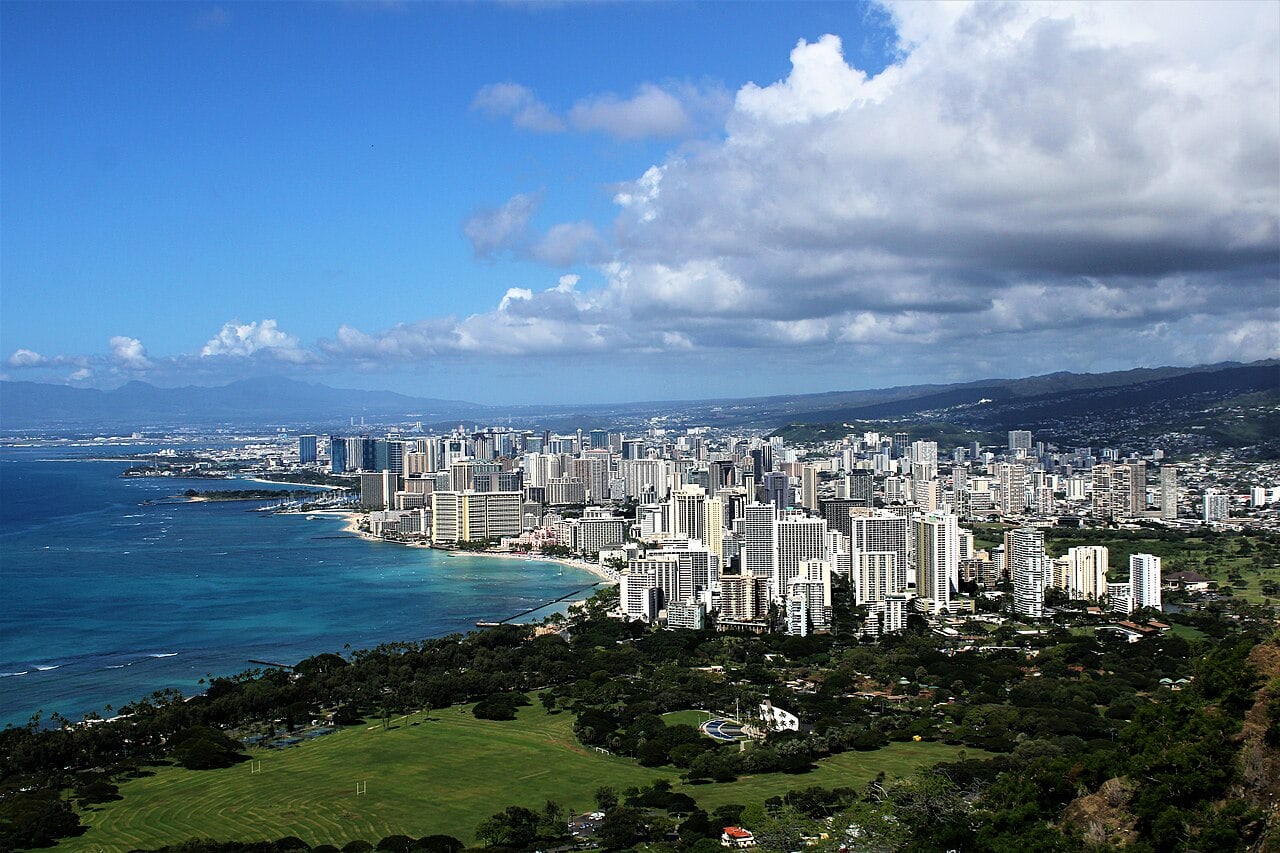
Honolulu is the largest city in the most isolated state in the country, and its prices reflect it. Almost everything that is consumed here arrives by ship or plane, and housing is limited by the geography of Oahu. Budgeting in Honolulu is mostly a way to see how rent, groceries and electricity fit into a paycheck that may also depend on tourism.
An island economy with three pillars
Tourism is the largest private-sector driver. Waikiki hotels, restaurants, tour operators and the airport employ many workers, and their hours and tips can follow the seasons. The military is the second pillar, with Joint Base Pearl Harbor-Hickam and other installations employing service members and civilians. Government and health care complete the picture, with state and city jobs and the region’s hospitals.
Service workers and tipped employees see income that varies. Military and government pay is steady. Many households combine them, with one stable paycheck and one that rises and falls. In Monthly, you log each deposit when it arrives and the app combines them for the month, so the variable one does not make the whole plan guesswork.
The General Excise Tax
Hawaii does not have a traditional sales tax. It has a General Excise Tax, a levy on the gross income of businesses, which is commonly passed through to customers. The state rate is 4%. Oahu adds a county surcharge of 0.5%, which brings the combined rate to 4.5%, and businesses often pass it on at about 4.712% because the tax is itself taxed, according to published tax guides. It applies to a wide range of goods and services, including food, which surprises people who move from states where groceries are exempt.
For budgeting, this means that the receipt total is the figure to log. Do not compare prices based on sticker price alone.
Rent and electricity
Rent in Honolulu is among the highest in the nation, and many households share housing to cope. Multigenerational living is common, as are roommate arrangements in Kaimuki, Mo’ili’ili and Kalihi. Add your own share of rent as a fixed expense, and anything you advance for the household under money owed.
Electricity in Hawaii is among the most expensive in the country, according to US federal data, because the islands depend heavily on imported fuel. Air conditioning is less common than in the mainland south, but dehumidifiers and fans add up. Update your electricity amount when the bill changes.
Getting around
Honolulu has TheBus and the Skyline rail line on the west side of Oahu, and many residents rely on a car. Parking in Waikiki and downtown is expensive. Car insurance, gas and a monthly parking fee are fixed items worth writing down. A person who commutes from Ewa Beach or Kapolei to town will pay for it in time and money, which Monthly will help you see.
Costs that arrive by ship
Because most goods are imported, grocery prices are higher than on the mainland, and many households do a monthly bulk trip to Costco or Sam’s Club. A flight to see family on the mainland or to another island is a major cost. Save for those in your weekend reserve or log them as one-time entries in the month you buy the ticket.
Weekend money
A day at Ala Moana Beach, a Sunday hike up Diamond Head, a poke bowl, a drive to the North Shore, or a weekend visit to Maui or the Big Island. Beaches are free, but parking, food and gear are not. Set a weekend reserve before the weekend, and keep inter-island trips as separate entries.
Savings and money owed
An employer retirement plan, a military Thrift Savings Plan, a savings account and a brokerage balance each get a line with a balance and a last-checked date. Nothing is connected and Monthly does not advise on investing. A flight fund is worth its own line here, since it sits beside the free money it competes with. Money you fronted for a family member’s ticket goes under money owed.
Two worked examples
Hypothetical example one: your pay is $3,700 a month. Your share of rent is $1,700, electricity $190, internet and phone $140, car insurance and parking $330, groceries as a fixed amount $700, and $250 toward a student loan. Fixed expenses total $3,310. With a $120 weekend reserve, real free money is $3,700 minus $3,310 minus $120, or $270.
Hypothetical example two: a slow-season month brings in $3,100 instead of $3,700. Free money becomes $3,100 minus $3,310 minus $120, or negative $330. The negative figure shows you need to trim the reserve or draw on savings, before rent is due.
Start small: enter your own share of rent, not the whole lease, with the $3,700 paycheck and the other fixed lines, and see whether $270 is what you thought you had. Enter your share of rent, not the whole lease, and see your real margin →
When the margin is this thin, a slow month decides whether you borrow. Test a slow-season paycheck against your fixed bills before the hours drop →
Frequently asked questions about Monthly in Honolulu
Everything you need to know before you start.
What is Hawaii's General Excise Tax and does it affect my budget?
How do I plan when tourism-season hours change my paycheck?
How do I plan an inter-island or mainland flight home?
Can I track shipping costs and Costco runs?
How do I organize paycheck Honolulu income if I share a home with relatives?
YOUR NEXT MONTH STARTS HERE
Start organizing your month in Honolulu today
Free. No bank connection. Start with your first entries.
Create my free budget- Free to use
- No credit card
- No bank connection