

Your monthly budget in Jacksonville.
Jacksonville is 874 square miles of port, Navy and bank jobs where the commute is part of the bill. Monthly shows your free money from entries you type in.
$0
Cost to use Monthly
At your pace
Start with your first entries
0
Bank accounts connected
100%
Your data stays yours
Sound familiar?
Bring your expenses in Jacksonville together and get a clearer view of the month.
Without Monthly
- You don't know your real free money until you've already spent it
- Fixed expenses catch you off guard every month even though they're always the same
- You reach the weekend without knowing if you can go out without overspending
- Your savings and investments are scattered across different places with no unified view
- Spreadsheets are a pain and banking apps mix everything together with no structure
With Monthly
- You see your real free money from day one of the month, before you spend a dollar
- You enter all your fixed expenses once and Monthly carries them into every new month
- The weekend reserve is already set aside before the week even starts
- All your investments logged in one place, no APIs or complications
- Your monthly budget in one app you can use from your phone
Everything you need to plan your month in Jacksonville
Monthly covers every part of your monthly finances, without the complications.
Paycheck and real free money
Enter your paycheck in Jacksonville and Monthly instantly calculates how much free money is left after every commitment for the month.
Fixed expenses under control
Rent, utilities, card payments and subscriptions in Jacksonville organized in one place. No surprises at the end of the month.
Weekend reserve
Set aside money for going out before you spend it. Four weekends, four reserves. Never reach Sunday wondering where it all went.
Investments and savings
Log your savings, retirement account, brokerage holdings or anything else. No APIs or live prices. Just your own numbers, always at hand.
Money owed to you
Lent money to someone? Log it in Monthly. Nothing forgotten, nobody made to feel awkward about asking for it back.
Optional AI assistant
Ask about your records and review your budget with the assistant. You choose whether to enable it and which decisions to make.
How to organize your month in Jacksonville with Monthly
Start with your income and fill in your plan at your own pace.
Enter your paycheck
The starting point. Your take-home pay for the month, entered in seconds at the start of each period.
Add fixed expenses
Rent, utilities and card payments in Jacksonville. Everything you already know is coming, in one place.
Set the weekend reserve
Decide how much you want available each weekend and Monthly sets it aside automatically from the plan.
Log investments and debts
Savings, retirement accounts, brokerage holdings, whatever applies. All noted down without relying on live prices.
See your real free money
The number that matters: how much you can spend without touching the rest of the month. No surprises, no guilt.
How to organize your month in Jacksonville without constantly putting out fires
A concrete guide to lowering financial anxiety and gaining clarity with your paycheck, fixed expenses, reserves and investments.
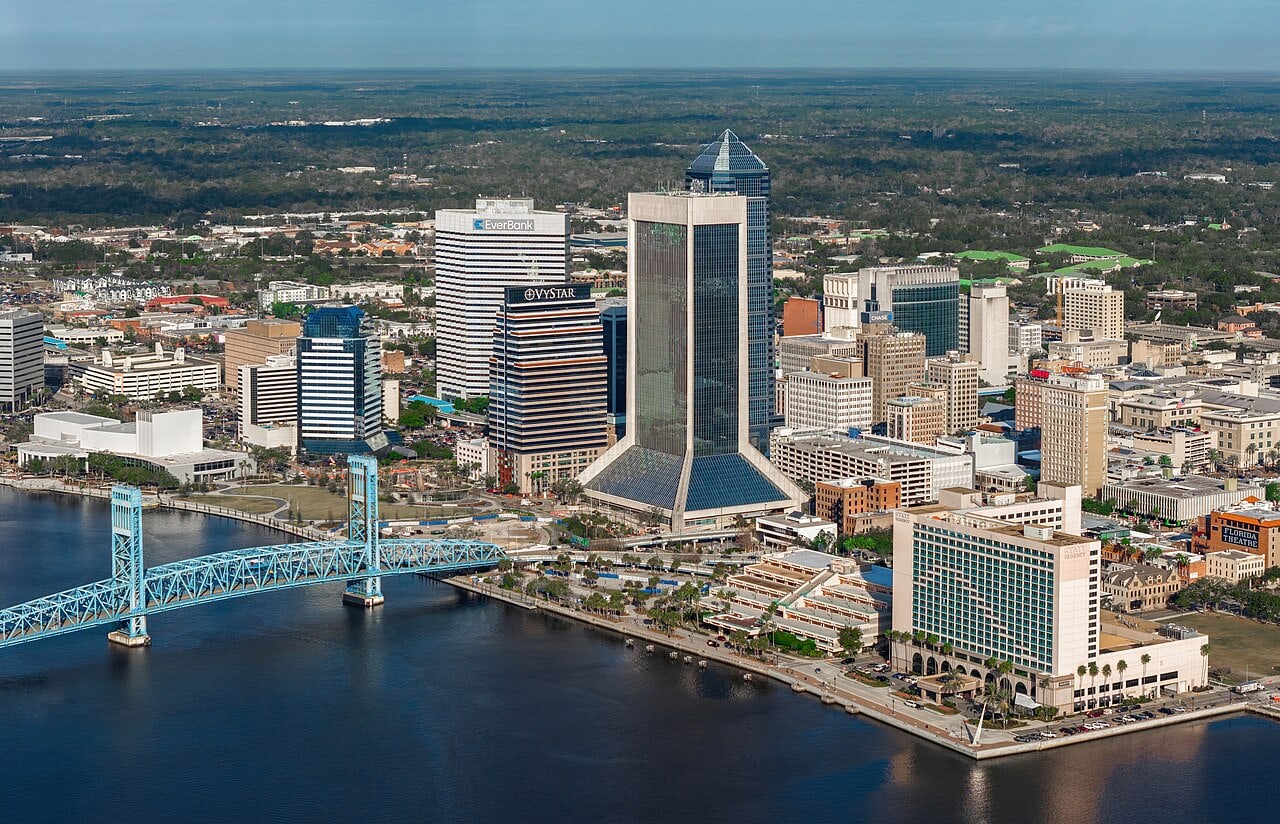
Jacksonville is the most populous city in Florida, with 949,611 residents at the 2020 census, and at about 874 square miles it is the largest city by area in the contiguous United States. It straddles the St. Johns River, with Atlantic beaches at Jacksonville Beach, Atlantic Beach and Neptune Beach. Before picking a budget app for managing money in Jacksonville, think about distance: in a city this large, how far you live from work is as much a part of the budget as rent.
A port, a Navy town and a banking center
Wikipedia calls JAXPORT Florida’s largest seaport by volume. Naval Station Mayport, Naval Air Station Jacksonville and the Marine Corps’ Blount Island Command are also in the city. Banking, insurance, health care and logistics are significant employers, and the PGA Tour is headquartered in nearby Ponte Vedra Beach.
That adds up to a labor market with several rhythms. Port and warehouse jobs run in shifts that vary with ship schedules and freight volume. Base jobs pay on a federal schedule. Office jobs in finance and insurance pay a regular salary, sometimes with a bonus. Households often combine two of these, which makes a monthly view of both checks more informative than looking at either alone.
The commute is the biggest hidden bill
Jacksonville grew along both sides of a river, and it grew outward. Many households live on one side and work on the other, and the bridges (the Main Street Bridge, the Mathews Bridge and the Dames Point Bridge among them) are part of the daily route. Public transit exists, but most residents rely on a car.
For a car-dependent household the cost is predictable and easy to underestimate. Fuel for a 25-mile commute each way adds up. So do tires, brakes, oil changes and insurance. Calculate a per-month number from your own odometer and enter it as a fixed line. Then compare it with what you would pay to live closer. The rent on a place near work can look high until you add what a longer commute costs.
Florida has no income tax, so look at what else is there
Florida has no state personal income tax, so your paycheck is reduced only by federal taxes and payroll taxes. The real costs show up elsewhere: car insurance, homeowner’s or renter’s insurance, electricity in summer, and vehicle registration. These tend to come as annual or semiannual bills, and a household can feel fine until one of them arrives.
List each as a monthly slice. A $720 semiannual car insurance bill is $120 a month. Add it, and the amount that shows as free money on payday is already net of it.
Mayport, Blount Island and the military paycheck
Military households in Jacksonville see a steady paycheck and a predictable set of costs, with the occasional deployment or move changing the pattern. The sensible approach is to enter the pay, enter housing and the car, and look at the remainder, then add moving costs or deployment-related changes in the month they happen.
For a household in which one partner is in the Navy and the other works a civilian job, the two checks arrive on different schedules. Treat them as separate income lines, and use the combined total against the fixed list. If the base paycheck covers rent, the car and insurance on its own, the civilian check is genuinely flexible.
Warehouse and port shifts
The port and logistics sector is the other half of the city’s employment. Hours can change with vessel schedules and freight volume, and an overtime week or a short week changes the check. Do not plan on the best week. Look at the last three pay periods, plan on the lowest, and treat the rest as extra when it lands.
If you work a night shift, move your weekend reserve to your days off, since your weekend may fall midweek.
Football, beaches and the weekend
The Jaguars have played in Jacksonville since the franchise was awarded in 1993, and the city hosted Super Bowl XXXIX in 2005. A home game, a day at Jacksonville Beach or a dinner on the river is the kind of weekend that does not look expensive purchase by purchase.
A weekend reserve is the simplest guard. Set the number before Friday and track what is left on Sunday evening. In football season, set a separate number for game days so that eight Sundays do not become eight unplanned months.
Far from work, then closer
First, an invented warehouse employee with a long commute. Net pay is $3,380 a month. Rent is $1,300, car payment and insurance $510, electricity $170, internet and phone $125, fuel for the commute $260, groceries as a fixed $410 and a monthly slice of $60 for registration and repairs. Fixed expenses total $2,835. With a $130 weekend reserve, the month leaves $3,380 minus $2,835 minus $130, or $415.
Second, the same worker moving closer. Rent rises by $250 to $1,550 and the commute drops to $90 of fuel. Fixed expenses become $2,835 plus $250 minus $170, or $2,915. The month leaves $3,380 minus $2,915 minus $130, or $335. The move costs $80 more a month, but it gives back the driving time, which can go to extra shifts or rest. That is a trade the numbers can show before the lease is signed.
First move: enter your fuel, tires and insurance as one commute line, and then enter a closer apartment’s rent next to it. Enter your commute and rent for two addresses and see which one leaves more →
Retirement, emergency fund and carpool money
A military or employer retirement plan, a savings account and a small emergency fund can each go in as an entry with a balance and a date. They are not linked to anything, and the app suggests no investments. Gas money a carpool partner owes you, or a game-day ticket you bought for a group, sits under money owed. How Monthly works is the quick tour.
Why manual entry fits a city this size
Distance makes bills irregular: a tire, a toll, a long week. Entering them yourself, as they happen, keeps the plan tied to your actual month, with nothing posting that you did not choose.
After the next shift, enter the check. Enter your last paycheck and your commute, then see what a week of overtime has to cover →
Frequently asked questions about Monthly in Jacksonville
Everything you need to know before you start.
I work a warehouse shift near the port and live on the Southside. What is the commute really costing me?
I am stationed at Mayport and my spouse works downtown. How do we split the plan?
Florida has no income tax. Does that mean I can skip the tax line?
Football season brings Jaguars home games. How do I keep them from taking over a month?
I live at the beach and work inland. Is there a cost I might be missing?
YOUR NEXT MONTH STARTS HERE
Start organizing your month in Jacksonville today
Free. No bank connection. Start with your first entries.
Create my free budget- Free to use
- No credit card
- No bank connection