

Your monthly budget in Virginia Beach.
Virginia Beach pays in tourist-season swings and Navy-base steadiness. Monthly turns your deposits and bills into one free-money number, no bank link.
$0
Cost to use Monthly
At your pace
Start with your first entries
0
Bank accounts connected
100%
Your data stays yours
Sound familiar?
Bring your expenses in Virginia Beach together and get a clearer view of the month.
Without Monthly
- You don't know your real free money until you've already spent it
- Fixed expenses catch you off guard every month even though they're always the same
- You reach the weekend without knowing if you can go out without overspending
- Your savings and investments are scattered across different places with no unified view
- Spreadsheets are a pain and banking apps mix everything together with no structure
With Monthly
- You see your real free money from day one of the month, before you spend a dollar
- You enter all your fixed expenses once and Monthly carries them into every new month
- The weekend reserve is already set aside before the week even starts
- All your investments logged in one place, no APIs or complications
- Your monthly budget in one app you can use from your phone
Everything you need to plan your month in Virginia Beach
Monthly covers every part of your monthly finances, without the complications.
Paycheck and real free money
Enter your paycheck in Virginia Beach and Monthly instantly calculates how much free money is left after every commitment for the month.
Fixed expenses under control
Rent, utilities, card payments and subscriptions in Virginia Beach organized in one place. No surprises at the end of the month.
Weekend reserve
Set aside money for going out before you spend it. Four weekends, four reserves. Never reach Sunday wondering where it all went.
Investments and savings
Log your savings, retirement account, brokerage holdings or anything else. No APIs or live prices. Just your own numbers, always at hand.
Money owed to you
Lent money to someone? Log it in Monthly. Nothing forgotten, nobody made to feel awkward about asking for it back.
Optional AI assistant
Ask about your records and review your budget with the assistant. You choose whether to enable it and which decisions to make.
How to organize your month in Virginia Beach with Monthly
Start with your income and fill in your plan at your own pace.
Enter your paycheck
The starting point. Your take-home pay for the month, entered in seconds at the start of each period.
Add fixed expenses
Rent, utilities and card payments in Virginia Beach. Everything you already know is coming, in one place.
Set the weekend reserve
Decide how much you want available each weekend and Monthly sets it aside automatically from the plan.
Log investments and debts
Savings, retirement accounts, brokerage holdings, whatever applies. All noted down without relying on live prices.
See your real free money
The number that matters: how much you can spend without touching the rest of the month. No surprises, no guilt.
How to organize your month in Virginia Beach without constantly putting out fires
A concrete guide to lowering financial anxiety and gaining clarity with your paycheck, fixed expenses, reserves and investments.
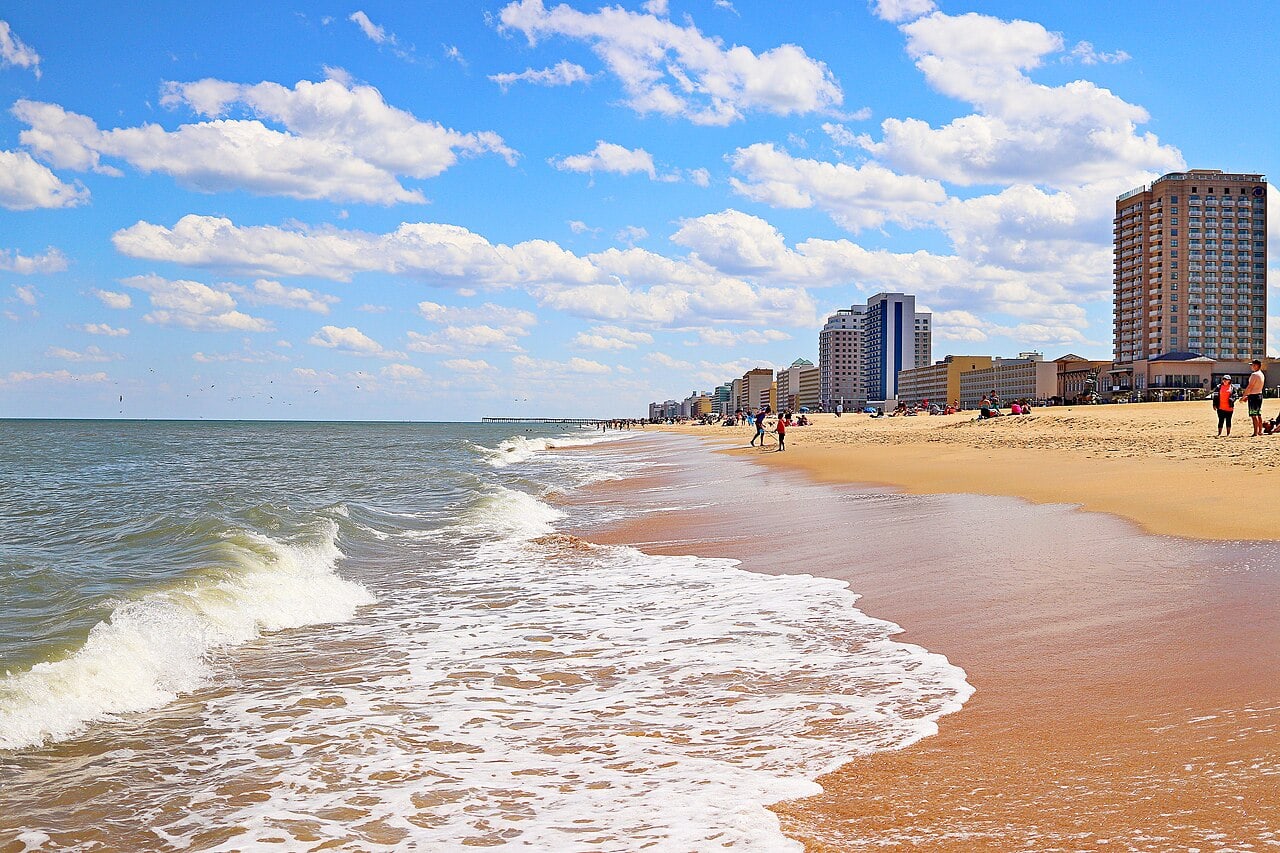
Virginia Beach is the most populous city in Virginia, with 459,470 residents at the 2020 census. It is also two economies in one town. NAS Oceana is the city’s largest employer, according to Wikipedia, and the area also hosts Joint Expeditionary Base East and, mostly within city limits, Naval Amphibious Base Little Creek. Alongside the base payrolls sits a resort strip with miles of beach and hundreds of hotels, motels and restaurants. A budget app for managing money in Virginia Beach has to fit one of those two rhythms, or a household that lives in both.
A year of paychecks, read as two halves
Tourism spending in a resort city does not arrive evenly. Wikipedia cites an estimate of $857 million in visitor spending and 14,900 jobs supported by tourism, which means many households depend on the summer. A line cook, a surf instructor, a hotel front desk agent and a parking attendant all earn more in June than in January, and most of them pay the same rent in both.
The simplest way to plan is to pair the months. Look at the best summer month and the weakest winter month, and put both in front of you. The aim is not to predict next year. It is to see how much of July has to stay in the account to cover February.
The bases and the steady check
NAS Oceana, Joint Expeditionary Base East and Little Creek mean that a lot of the city’s income is predictable. Military pay, civilian defense jobs and contractor salaries come in on a schedule, and many of those households are also the ones with a second income from a spouse who works in a hotel, a restaurant or a school.
A mixed household has an advantage if it uses it. Put the steady paycheck on one line and the variable one on another. Check how much of the fixed bills the steady line covers by itself. If it covers rent, the car note and insurance, every dollar from the second job is genuinely flexible. If it does not, you know how much of the seasonal income is already committed.
The Oceanfront calendar
Virginia Beach lives by its events. The Neptune Festival, the East Coast Surfing Championships, the American Music Festival and the Rock ‘n’ Roll Half Marathon all draw people to the Oceanfront, according to Wikipedia. A 2023 economic study reported by WTKR put the Neptune Festival’s Boardwalk Weekend at roughly 212,000 people and an economic impact of about $24.5 million to $27.7 million, though the study was commissioned for the festival.
For a resident the question is about costs on the other side of the counter. Parking, food, a hotel for out-of-town family and the time you do not work all carry a price. Decide before an event weekend whether you are working it, attending it or avoiding it, and put a number on that choice in your weekend reserve.
Water, tunnels and the commute
About half of the city’s 497 square miles is water, and the region is stitched together by bridges and tunnels. The southern end of the Chesapeake Bay Bridge-Tunnel is here, and the Hampton Roads metro has more than 1.8 million residents. Crossing a bridge or tunnel to work in Norfolk, Chesapeake or Newport News is routine, and traffic can mean fuel, wear and a longer day.
Put the commute in as a real monthly number: fuel, tolls where they apply, insurance and a slice for tires and oil. If the numbers for a closer job and a farther one are different, compare them in the plan instead of in your head.
Floods and the storm cushion
Low ground, tidal water and heavy rain are a recurring fact of life. During Hurricane Matthew, rain flooded more than 2,000 homes in Virginia Beach, and some neighborhoods had standing water for days. Not everyone is exposed, but anyone who rents or owns near the water should know what their policy covers, since standard renter’s and homeowner’s policies commonly exclude flood. A flood premium and a small storm cushion belong in the plan alongside rent.
What Virginia takes from a paycheck
Virginia has a graduated income tax, running from 2% to 5.75%, according to the Tax Foundation. The top rate applies to taxable income above $17,000, so most full-time earners reach it on part of their pay. For tipped and hourly workers, the practical lesson is to compare gross hours with the deposit that actually reaches your account, and to enter the deposit.
A July and a February
Begin with a strong summer month for an imagined server at an Oceanfront restaurant. Wages and tips deposited total $3,700. Rent is $1,350, utilities $160, phone and internet $125, car payment and insurance $470, groceries as a fixed $400, a credit card minimum of $95, and a $10 monthly slice for car registration. Fixed expenses come to $2,610. With a $180 weekend reserve, the month leaves $3,700 minus $2,610 minus $180, or $910.
Now the slow February. Deposits drop to $2,460 and the same bills apply. The month leaves $2,460 minus $2,610 minus $180, or negative $330. Next to the summer figure of $910, the shortfall is already covered by the first month, if $330 of summer money stays in reserve. If only $500 stays, the gap is covered with room to spare.
First move: enter your best month and your slowest month of the past year, with the same six bills under both, and look at the gap. Enter your best and worst months from last year and see how much summer has to carry →
The storm fund and other balances
The balance that matters most here is the storm fund, so give it its own line next to any military or employer retirement plan and a brokerage balance, each with the date you last checked. Those lines are notes you type; Monthly does not link to the accounts or suggest investments. A shipmate or coworker who owes you for a shared dinner goes under money owed. Each piece of the app is described in the feature overview.
Why manual entry works for seasonal pay
Seasonal income needs a plan that shows what you earned, not what an automated feed expects. When you enter each deposit and each bill yourself, February shows up as February. Nothing links to your bank, and nothing changes the figure behind your back.
After your next shift or payday, put in the deposit and the bills before you spend. Log this week’s tips and see whether this month is on track to cover February →
Frequently asked questions about Monthly in Virginia Beach
Everything you need to know before you start.
I wait tables at the Oceanfront. How do I budget when July pays double February?
How many people actually come to the Oceanfront each fall for the Neptune Festival?
My spouse is in the Navy and I work at the Beach. Does Monthly handle two different pay patterns?
What if a storm floods my street and my road is closed for a shift?
Do the tunnels and bridges around Hampton Roads belong in a budget?
YOUR NEXT MONTH STARTS HERE
Start organizing your month in Virginia Beach today
Free. No bank connection. Start with your first entries.
Create my free budget- Free to use
- No credit card
- No bank connection