

Your monthly budget in Cheyenne.
Cheyenne pays through state government, F.E. Warren and the railroads, with no state income tax. Monthly shows what is free after bills and rodeo week.
$0
Cost to use Monthly
At your pace
Start with your first entries
0
Bank accounts connected
100%
Your data stays yours
Sound familiar?
Bring your expenses in Cheyenne together and get a clearer view of the month.
Without Monthly
- You don't know your real free money until you've already spent it
- Fixed expenses catch you off guard every month even though they're always the same
- You reach the weekend without knowing if you can go out without overspending
- Your savings and investments are scattered across different places with no unified view
- Spreadsheets are a pain and banking apps mix everything together with no structure
With Monthly
- You see your real free money from day one of the month, before you spend a dollar
- You enter all your fixed expenses once and Monthly carries them into every new month
- The weekend reserve is already set aside before the week even starts
- All your investments logged in one place, no APIs or complications
- Your monthly budget in one app you can use from your phone
Everything you need to plan your month in Cheyenne
Monthly covers every part of your monthly finances, without the complications.
Paycheck and real free money
Enter your paycheck in Cheyenne and Monthly instantly calculates how much free money is left after every commitment for the month.
Fixed expenses under control
Rent, utilities, card payments and subscriptions in Cheyenne organized in one place. No surprises at the end of the month.
Weekend reserve
Set aside money for going out before you spend it. Four weekends, four reserves. Never reach Sunday wondering where it all went.
Investments and savings
Log your savings, retirement account, brokerage holdings or anything else. No APIs or live prices. Just your own numbers, always at hand.
Money owed to you
Lent money to someone? Log it in Monthly. Nothing forgotten, nobody made to feel awkward about asking for it back.
Optional AI assistant
Ask about your records and review your budget with the assistant. You choose whether to enable it and which decisions to make.
How to organize your month in Cheyenne with Monthly
Start with your income and fill in your plan at your own pace.
Enter your paycheck
The starting point. Your take-home pay for the month, entered in seconds at the start of each period.
Add fixed expenses
Rent, utilities and card payments in Cheyenne. Everything you already know is coming, in one place.
Set the weekend reserve
Decide how much you want available each weekend and Monthly sets it aside automatically from the plan.
Log investments and debts
Savings, retirement accounts, brokerage holdings, whatever applies. All noted down without relying on live prices.
See your real free money
The number that matters: how much you can spend without touching the rest of the month. No surprises, no guilt.
How to organize your month in Cheyenne without constantly putting out fires
A concrete guide to lowering financial anxiety and gaining clarity with your paycheck, fixed expenses, reserves and investments.
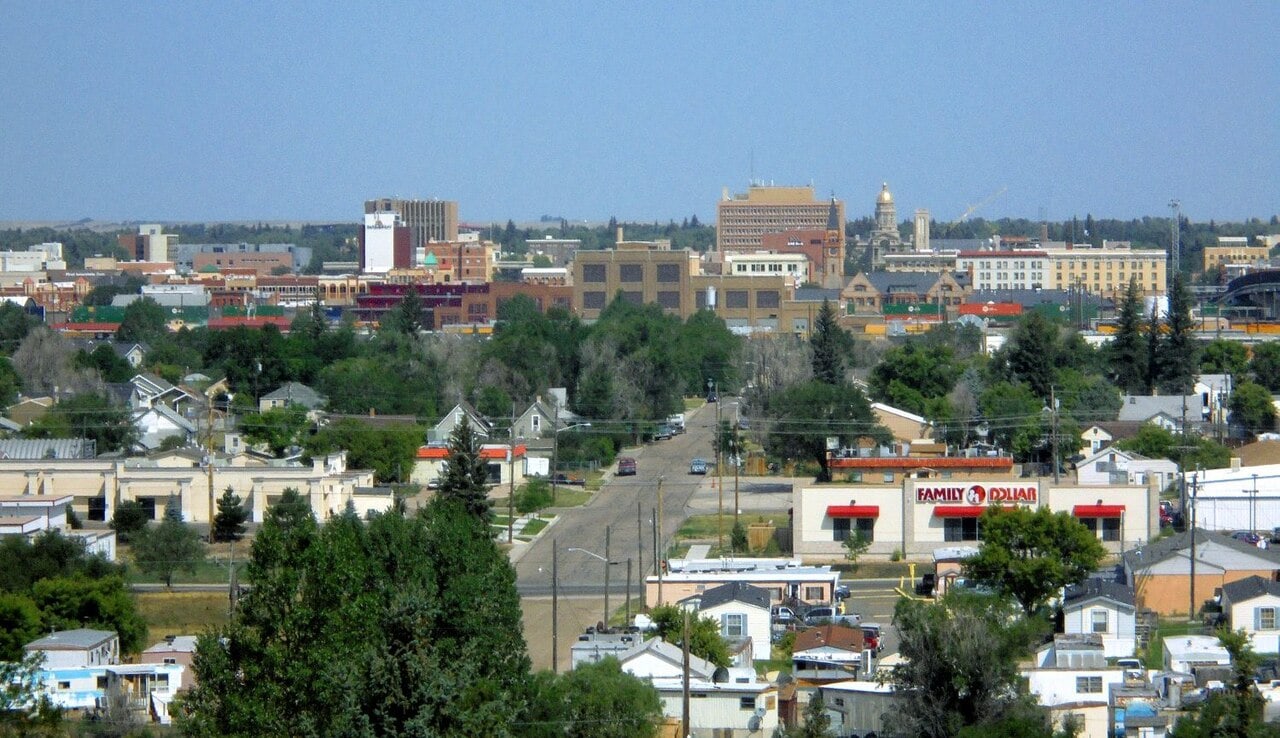
Cheyenne is the capital and the most populous city in Wyoming, with 65,132 residents at the 2020 census. It was founded in 1867 as a Union Pacific junction, and it is the only city ever to serve as the state’s capital. Wikipedia describes the economy as anchored by government services, transportation and military operations, including Francis E. Warren Air Force Base, with data centers and renewable energy emerging. A budget app for managing money in Cheyenne mostly serves households on a steady public-sector, railroad or base-related paycheck.
Rodeo week as a financial event
Few cities have a single event that shapes a whole summer. Cheyenne Frontier Days has run since 1897, for ten days around the last full week of July, and Wikipedia calls it the largest outdoor rodeo and western festival in the world. For households that work in food service, retail, security or hospitality, that week can mean extra shifts. For everyone else, it means crowds, closed streets and a calendar full of invitations.
The sensible way to treat it is as a planned line. Decide by June whether it is income, spending or a week to leave town, and enter the amount before July. If you work extra, enter the pay when it is deposited. If you go, set the weekend reserve for the entire run and treat it as a ceiling.
A tax-free paycheck, with caveats
Wyoming does not tax personal income, according to several tax guides. For a worker, that means a paycheck with no state income tax withholding.
That is a real advantage, and it can create a false sense of room. Federal income tax and payroll taxes still apply, and sales taxes, vehicle registration and property taxes remain. Put the annual items in as monthly slices. A $480 registration and property tax bill is $40 a month, and it belongs in the fixed list long before the due date arrives.
Three employers, three pay cycles
Government services, transportation and military jobs account for much of the city’s work, and they do not pay in the same way. State and city employees follow public pay schedules. The Union Pacific and BNSF railroads intersect in Cheyenne and both operate railyards there, which means railroad jobs on a different schedule. F.E. Warren Air Force Base employs service members and civilians.
In a household with two of these, the checks can arrive on different days. List each as its own income and look at the monthly total against the fixed bills. If the steadier check covers rent and the car note, every other dollar is genuinely flexible. If it does not, you know how much of the other check is already spoken for.
Altitude and the winter road
Cheyenne sits at about 6,086 feet, with a cold semiarid climate and about 15.9 inches of precipitation a year. I-25 and I-80 intersect southwest of the city, which is why trucking and distribution are part of the economy. They are also why storm closures matter. A household that depends on a drive to work should have a cushion for a hotel night, a tow or a missed shift.
Altitude and cold also affect the car. Cold starts, snow tires and a heavier use of the heater all show up as higher costs. A monthly slice for tires, battery and winter repairs is more realistic than treating them as surprises.
Heating and the cost of a cold house
Winters here are cold, and heating is a significant line from the fall through the spring. Update the utility entry after the first cold bill, and again in March. If you rent, check whether heating is included before you assume it is not. If you own, add a monthly figure for furnace upkeep.
The cost side of a small capital
Cheyenne is a small city with a modest population, and for many residents that is the point. Housing is the largest fixed cost, followed by the car, since most households drive. Compare what you spend on each with what you earn, and the picture is usually clear within one month of entries. The state’s size means there are fewer employers to choose from, so a household that depends on one should keep a larger cushion.
A state salary and a rodeo-week household
First, an invented state employee. Net pay is $3,500 a month. Rent is $1,150, groceries as a fixed $420, car payment and insurance $450, heating and electricity $165, internet and phone $125, and a $40 slice for registration and property tax. Fixed expenses total $2,350. With a $130 weekend reserve, the month leaves $3,500 minus $2,350 minus $130, or $1,020.
Second, an invented two-income household in July. A base paycheck brings $2,900 and a retail job adds $1,350 in a month with extra Frontier Days shifts, so income is $4,250. Rent is $1,350, utilities $150, phones and internet $190, two cars $720, groceries $560, and the $40 slice, so fixed expenses total $3,010. With a $350 reserve for rodeo week, the month leaves $4,250 minus $3,010 minus $350, or $890. Without the extra shifts, income is $2,900 and the month leaves negative $460, so the extra pay is not spending money but the thing that holds the month together.
First move: enter the base paycheck and the second paycheck separately, and see which one carries the bills. Enter both paychecks and see which one covers rent →
Military and state retirement, plus rodeo tickets
A military or state retirement plan, an emergency savings account and a brokerage balance can each be entered with a balance and a date. Monthly links to none of them and recommends nothing. If you buy rodeo tickets for friends, track what they owe under money owed. The feature list covers each section in turn.
Why manual works in a small capital
In a smaller city, where the same few employers pay most households, a plan has to hold up to a change in one of them. Typing your own numbers means the plan changes when you change it, and there is no feed to fall out of sync. See how it works for the short version.
When the next paycheck arrives, put it in before July’s plans. Enter this month’s net pay and rodeo week’s reserve, then see what is left →
Frequently asked questions about Monthly in Cheyenne
Everything you need to know before you start.
Wyoming has no income tax. Does that make my plan simpler?
My household is a mix of a civilian job and an Air Force paycheck at F.E. Warren. How do I enter both?
Cheyenne Frontier Days is the last full week of July. Should I plan for it or avoid it?
I drive I-80 in the winter. What should a road-closure budget look like?
Is a data-center or warehouse job a steadier paycheck than a seasonal one?
YOUR NEXT MONTH STARTS HERE
Start organizing your month in Cheyenne today
Free. No bank connection. Start with your first entries.
Create my free budget- Free to use
- No credit card
- No bank connection