

Quick summary: For couples who want a single shared view, Honeydue, YNAB, Monarch and EveryDollar are built with that in mind. For couples who’d rather each keep their own simple budget and talk through shared costs, Monthly is a free individual tool that gives each partner a clear free-money number. The best choice depends on whether you want transparency by default or a conversation by design.
An app can’t fix a disagreement about money, but it can make sure both of you walk into it with facts. The apps below tackle that differently, so the first decision isn’t which app but which model: one shared system, or two individual budgets that meet in the middle.
How we compared these apps
This article comes from the Monthly team, and Monthly is in the list. We read each competitor’s official site for the features and prices below, and we left out anything we couldn’t confirm. We didn’t test these apps with real couples, and we’re not claiming any of them reduces arguments. Prices and features change, so verify before you commit.
We compared them on sharing, cost, whether a bank connection is needed, and how much effort they take.
1. Monthly: two individual plans, one honest conversation

A favor
- Core workflow is free
- No bank connection or account linking
- Each partner sees their own real free money
- Works in the browser on any phone or laptop
En contra
- No shared-budget mode
- Partners can't see each other's data in the app
- Manual entry
- Joint expenses need to be agreed outside the app
Monthly doesn’t have a shared mode, and that’s the design. Each partner enters their own take-home pay, fixed expenses and weekend reserve, and sees their own real free money. When it’s time to talk about rent, groceries or a trip, you each bring a clear number: “after my commitments I have $1,150 free this month”. That makes it easier to split costs in proportion to what each person can really afford, instead of defaulting to 50/50.
It suits couples who keep separate accounts, couples where incomes differ a lot, and anyone who doesn’t want to hand a partner or an app access to their accounts. It doesn’t suit couples who want to see each other’s transactions in real time. Both partners can use it on whatever device they own, since it runs in the browser.
2. Honeydue: built for couples, with chat

A favor
- Site lists balances, bills, budget, splits, activity and chat
- Available on iPhone and Android per its site
- Designed for couples from the start
En contra
- Pricing isn't stated on its site; check the store listing
- Site doesn't explain how accounts connect
- Third-party reviews describe it as fairly basic
Honeydue’s site lists balances, bills, budget, splits, activity and chat, and says it’s available for iPhone and Android. That feature list is what couples are usually after: a shared place for bills and a way to message about a charge. Some reviews describe it as free and basic, but its own site doesn’t state a price, so check the App Store or Google Play before relying on that. We also couldn’t confirm from its site how accounts are connected or how much each partner chooses to share, so read its privacy information first.
3. YNAB: a detailed shared method

A favor
- Subscription sharing included at no extra cost per its pricing page
- 34-day free trial listed, no card when signing up directly
- Detailed control over every dollar
- Free 365-day trial for college students per its site
En contra
- Listed at $14.99 per month or $109 per year
- Steeper learning curve
- Both partners need to buy into the method
YNAB’s pricing page says subscription sharing is included, so partners can use one subscription. The method asks you to give every dollar a job, which is powerful for a couple that wants to plan together and willing to hold a regular money meeting. It’s the heaviest option here in time and cost. See Monthly vs YNAB for the full comparison.
4. Monarch: household-oriented, paid

A favor
- Its site has a dedicated page for couples
- Pricing page lists $99.99 per year or $14.99 per month
- Connects accounts for automatic tracking
En contra
- Paid only
- Pricing page doesn't spell out how sharing works
- Requires bank connections
Monarch’s pricing page lists $99.99 a year or $14.99 a month and points to a page for couples. It’s a bank-connected, paid app, so it suits couples who want automatic tracking and are comfortable linking accounts. We couldn’t confirm sharing details from its pricing page, so check them before subscribing. Our Monthly vs Monarch Money article goes further.
5. EveryDollar: free manual budget with a household feature
A favor
- Free version includes a monthly budget and manual transactions
- Its page describes a household feature so couples manage one budget
- Sinking funds for future shared expenses
En contra
- Page doesn't say if the household feature is free or Premium
- Bank-connected transactions need Premium
- Zero-based method takes learning
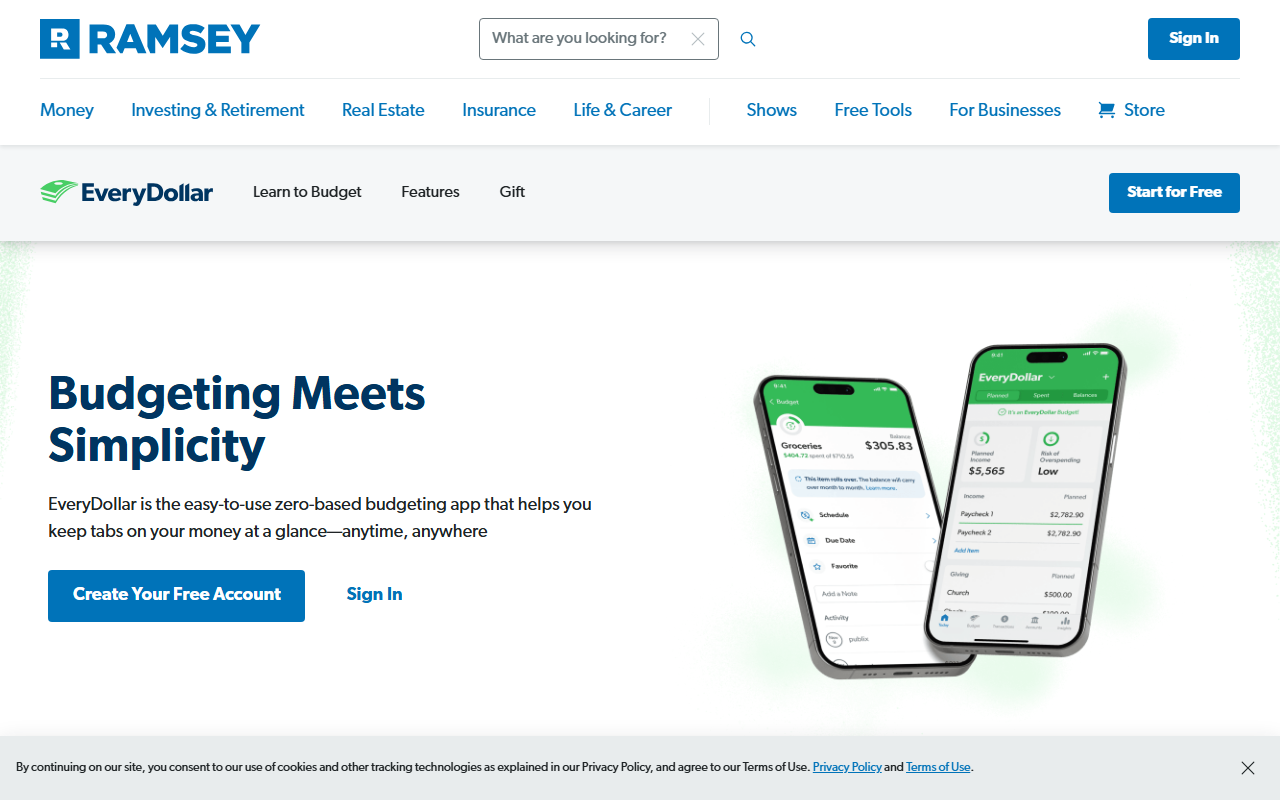
EveryDollar’s page says a household feature lets couples manage one budget together, each with a separate login. It doesn’t say whether that feature is free or paid, so check before relying on it. The free version is manual and includes sinking funds, which suit shared goals like a trip or a car repair.
Quick comparison
| App | Sharing model | Cost per its site | Bank link |
|---|---|---|---|
| Monthly | Individual budgets, shared by conversation | Free core workflow | None |
| Honeydue | Shared app with bills, splits, chat | Not stated on its site | Check its policy |
| YNAB | Shared subscription | $14.99/month or $109/year | Optional |
| Monarch | Household-oriented | $99.99/year or $14.99/month | Yes |
| EveryDollar | Household feature | Free manual; Premium $79.99/year | Premium only |
A worked example: splitting rent by income
Imagine Alex takes home $3,600 and Sam takes home $2,400. Their rent is $1,800. Split 50/50, each pays $900: that’s 25% of Alex’s pay and 37.5% of Sam’s. Split proportionally to income, Alex pays 60% ($1,080) and Sam 40% ($720), which is 30% of each person’s take-home.
Now each opens Monthly. Alex has fixed expenses of $1,080 rent plus $350 other bills and a $250 weekend reserve: $3,600 - $1,430 - $250 = $1,920 of real free money. Sam has $720 rent plus $300 other bills and a $200 reserve: $2,400 - $1,020 - $200 = $1,180. These amounts are hypothetical. The point isn’t who has more, but that each person can say a number and mean it. For the formula, see how to calculate real free money.
Moving in together or renegotiating rent? Each of you type your own paycheck, your half of the $1,800 and your own bills into Monthly tonight, then swap numbers over dinner →
Which should you pick
- You want separate, simple, free budgets: Monthly.
- You want one shared place for bills, splits and chat: Honeydue.
- You want to plan every dollar together and pay for it: YNAB.
- You want automatic tracking in a paid app: Monarch.
- You want a free manual shared budget: EveryDollar, after checking whether the household feature is included in the free version.
Shared or separate: choosing a model
Couples tend to fall into three patterns. In the first, everything is pooled: one set of accounts, one budget, full visibility. Shared apps with bank connections suit this best because there’s little to hide and a lot to reconcile. In the second, couples keep separate accounts and contribute to shared costs by an agreed formula. Individual budgets work well here, because each person needs to know their own number and the amount they owe the shared pot. In the third, a hybrid, there’s a joint account for household bills and separate accounts for personal spending, so an app needs to handle both or you use two tools.
None of these is the right one. The mismatch that causes trouble is when one partner wants full transparency and the other wants autonomy, and the tool forces a choice. If that sounds familiar, the conversation matters more than the app. Agree on what you’ll share, what you won’t, and how often you’ll check in.
A word on privacy: before connecting any account to a shared app, read what each partner can see and what the company stores. Tools that never ask for bank credentials, like Monthly, remove that question for your own data, but they also mean the app can’t show your partner anything. That’s a trade-off, not a flaw.
Habits that matter more than the app
- Schedule a short money check-in each payday.
- Agree how you split shared costs (equal or proportional) and write it down.
- Keep a small personal amount each that the other doesn’t question.
- Update numbers when something changes, such as a raise or a new bill.
Before you pick a shared app, pick a payday: on the next one, each of you enter your take-home and fixed bills in Monthly and compare the two free-money figures. If the gap surprises you, that conversation is worth more than any feature on this list. This article is informational and isn’t personalized financial advice.