

Short answer: for a shared household you usually need two things, not one: a shared ledger that records who paid and who owes, and a personal budget where your own share sits as a fixed cost. Splitwise is the best ledger for roommates; Honeydue and Monarch suit couples who want linked accounts in one place; Goodbudget syncs envelopes across phones. We rank Monthly first for the personal side, because it lets each person log their share of shared costs as a fixed expense without a joint account or a group app.
This is for anyone who lives with other adults and pays some bills on behalf of the house. Maybe you put the internet on your card, your roommate pays electricity, and someone does the big grocery run. Every month there is a moment where nobody is sure who is ahead. By the end of this article you’ll know which app fits your household, and how to keep your own budget accurate even when you front a bill.
How we compared them
Monthly is our own app, and its first place reflects the angle of this article: keeping each person’s plan clear inside a shared home. We checked each competitor’s official site or App Store listing in October 2026 for price and features. We did not test every app with a real household and did not use third-party ratings. Where an official page did not state a detail, we left it out.
Two different jobs: the ledger and the plan
Most frustration with “household budget apps” comes from asking one app to do two jobs.
The ledger answers “who owes whom?” It needs every shared bill, who paid it, and how it splits. Everyone in the house needs access.
The plan answers “what can I personally spend this month?” It needs your income, your share of the rent and bills, your own commitments, and nothing about your roommate’s car payment.
Rent is usually the largest line in both. The Census Bureau’s 2024 American Community Survey put the US median gross rent, which includes utilities paid separately, at $1,487 a month. Split three ways that is a modest number; on a single income it is a large one. Either way it belongs in your plan as a fixed cost, at your share, not at the full amount.
Quick comparison
| Rank | App | Job it does best | Price (October 2026) | Requires bank link? |
|---|---|---|---|---|
| 1 | Monthly | Your personal plan, with your share as a fixed expense | Free | No |
| 2 | Splitwise | Shared ledger for any group | Free; Pro in-app from $2.99 to $39.99 | No |
| 3 | Honeydue | Couples’ linked accounts and bills | Free; optional tips $0.99 to $9.99/month | Yes |
| 4 | Monarch | One combined household view | $99.99/year or $14.99/month | Yes |
| 5 | Goodbudget | Shared envelopes on several phones | Free plan; Premium $10/month or $80/year | No (sync on Premium) |
1. Monthly: your share, as a fixed expense

A favor
- Each person logs their own share of rent and bills as a fixed expense
- Money a roommate owes you can be recorded so it isn't forgotten
- Free, no bank link, works on the web and Android
- Free money shows what is truly yours to spend after shared costs
En contra
- Not a group ledger: roommates don't see each other's entries
- Manual entry for everything
- Settling up happens outside the app
Best for: each individual in a shared household who wants a clear personal number.
In Monthly you enter your income, then your share of shared costs as fixed expenses: “Rent (my third) $800”, “Internet (my half) $35”. Your own commitments sit beside them. The free-money figure reflects only what you are responsible for.
When you front a bill, log your share as the expense and record the rest as money owed to you. Your budget then shows your real position, not a month that looks worse because you paid for three people. Monthly is not a group app and does not show your roommates’ entries; pair it with a ledger if your house needs one.
2. Splitwise: the shared ledger

A favor
- Free version covers groups, equal or unequal splits, recurring bills and debt simplification
- CSV export and Venmo/PayPal payments in the US, per its App Store listing
- Everyone in the group sees the same balances
En contra
- Unlimited daily expenses, receipt scanning, charts and search are Pro
- Pro pricing varies by plan and country
- Tracks balances between people, not your monthly budget
Best for: roommate houses and any group that splits bills unevenly.
Splitwise’s App Store listing says you can keep using it free without Pro, and lists Pro in-app purchases between $2.99 and $39.99. Its Pro page puts unlimited expenses, receipt scanning, currency conversion and spending charts behind the subscription. It is the clearest answer to “who owes whom,” and nothing more. That focus is a strength; just don’t expect it to tell you whether you can afford a concert.
3. Honeydue: built for couples with linked accounts

A favor
- Free download; the only in-app purchases listed are optional monthly tips
- Each partner chooses how much to share
- Bill reminders, household category limits and chat about purchases
En contra
- Requires linking bank accounts to be useful
- Designed for two partners, not a roommate group
- Shared visibility of transactions isn't for every couple
Best for: couples who are comfortable linking accounts and want to talk about spending in one place.
Honeydue’s App Store listing describes bill reminders, monthly household spending limits per category, and the option to choose how much each partner shares. It is free, with optional tip subscriptions. For a couple splitting a household it does the ledger and part of the plan together, at the cost of shared bank data.
4. Monarch: one view for the whole household
A favor
- Added household members are included in the same subscription, per its couples page
- Combines separate and joint accounts in one view
- Each partner keeps their own login
En contra
- $99.99 a year or $14.99 a month
- Collaborators get full visibility of shared accounts
- Requires linking accounts
Best for: couples who have merged most of their finances and want one dashboard.
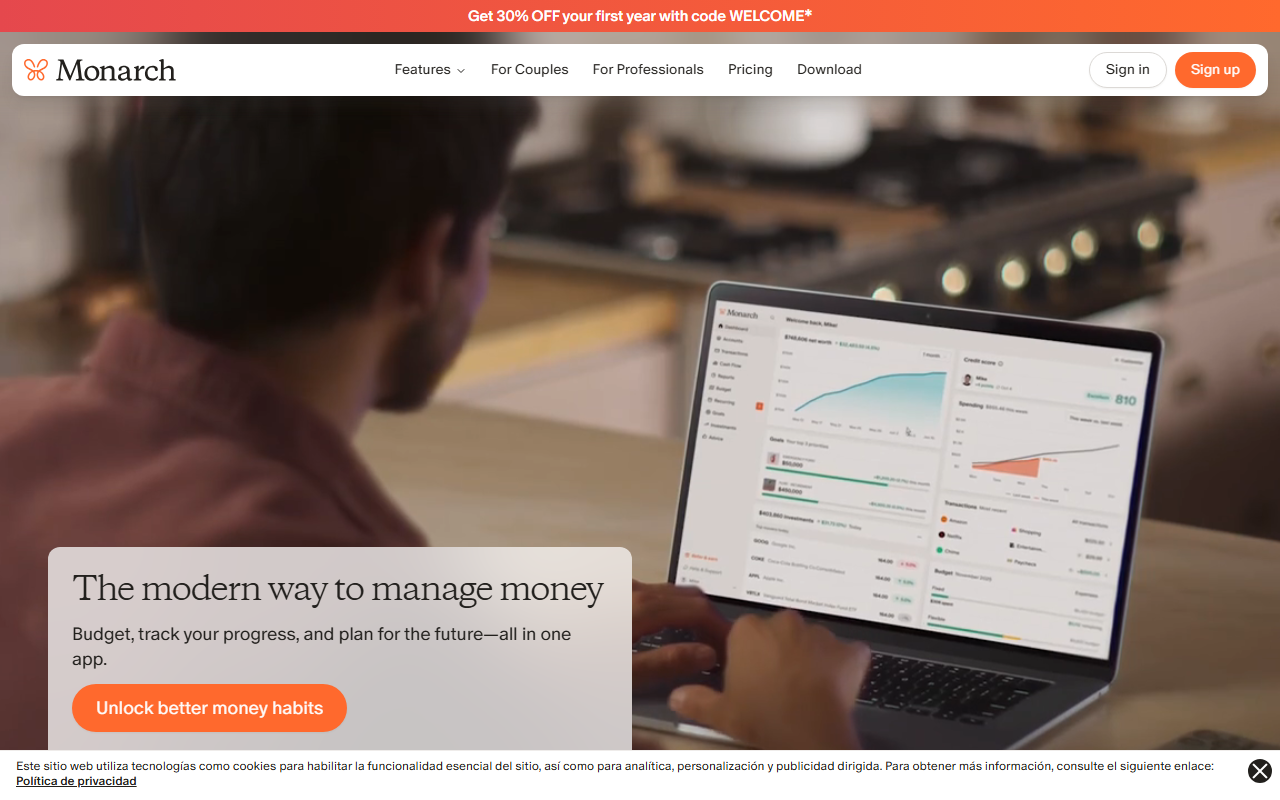
Monarch’s pricing page lists $99.99 yearly or $14.99 monthly, and its couples page says it costs nothing to add members of your household to the same subscription. That is good value for two people, but it assumes both of you want to see everything. Roommates rarely do.
5. Goodbudget: the same envelopes on every phone
A favor
- Free plan: 10 regular plus 10 additional envelopes, 2 devices
- Premium raises the limit to 5 devices
- No bank link required to use envelopes
En contra
- Premium is $10 a month or $80 a year
- Everyone has to fill and log envelopes consistently
- Built for a shared budget, not for tracking who owes whom
Best for: a couple or small household that runs one shared grocery and utilities budget.
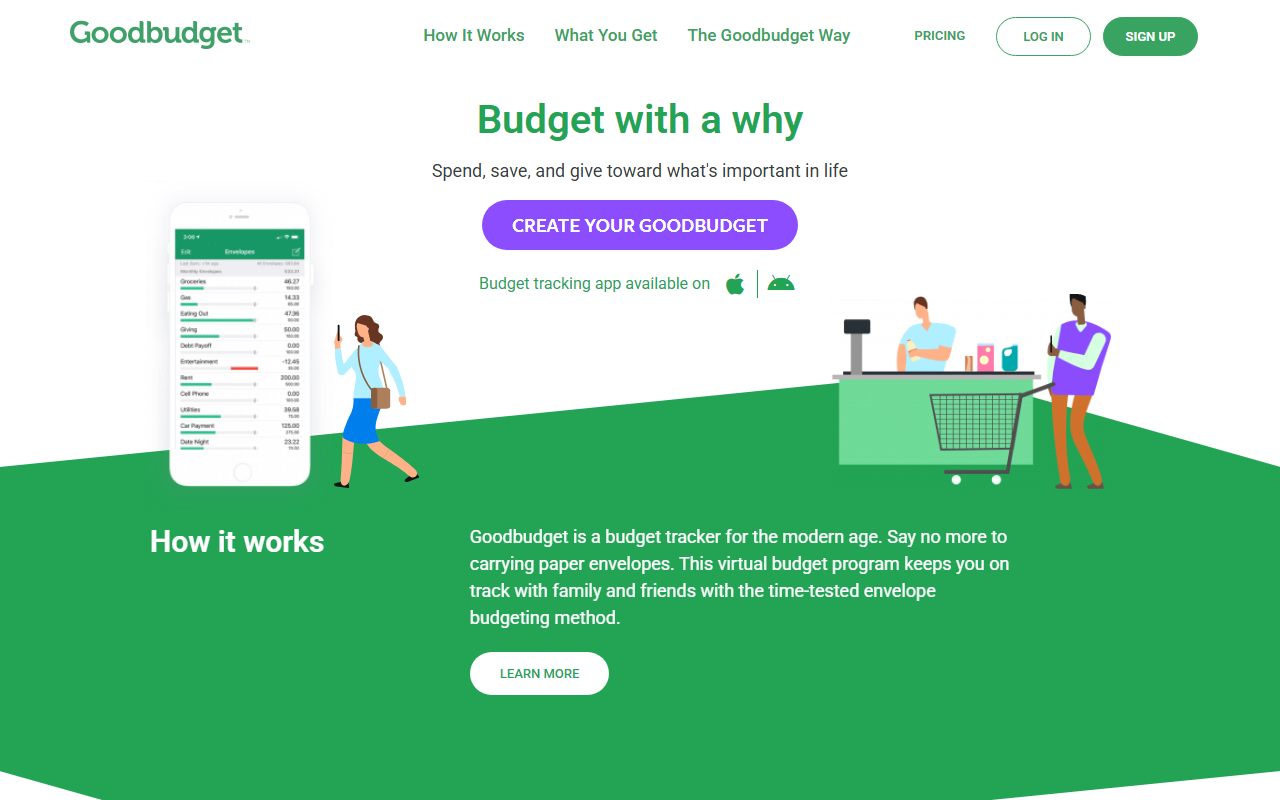
Goodbudget’s sign-up page lists two devices on the free plan and five on Premium, so two partners can share a free account. It works well when the household has agreed to pool money for certain categories. It is weaker when each person pays different bills and needs to settle up.
A worked example: three roommates, one card doing the heavy lifting
The figures are invented. Three roommates rent a $2,400 apartment, split evenly at $800 each. Jordan puts internet ($75) and electricity ($135 this month) on a card. Sam does a $210 grocery run for shared basics.
The shared ledger (Splitwise or similar) records: Jordan paid $210 in utilities, each share is $70. Sam paid $210 in groceries, each share is $70. Net: Alex owes Jordan $70 and Sam $70; Jordan and Sam cancel out.
Jordan’s personal plan in Monthly, on a $3,600 take-home month:
| Entry | Amount |
|---|---|
| Income | $3,600 |
| Rent share (fixed) | -$800 |
| Internet + electricity share (fixed) | -$70 |
| Shared groceries share | -$70 |
| Car payment (fixed) | -$290 |
| Phone (fixed) | -$55 |
| Weekend reserve | -$250 |
| Free money | $2,065 |
| Money owed to Jordan (noted, not spent) | $70 from Alex |
If Jordan had logged the full $210 of utilities as an expense, free money would read $1,925, and Jordan might skip something affordable or, once repaid, double-count the money. Logging the share plus a note of what is owed keeps the number honest in both directions.
Which app for which household
| Your household | Ledger | Personal plan |
|---|---|---|
| Three or more roommates | Splitwise | Monthly |
| Couple, separate finances | Splitwise or a shared note | Monthly, one account each |
| Couple, merged finances | Monarch or Honeydue | Same app, or Monthly for personal spending |
| Couple pooling some categories | Goodbudget | Goodbudget or Monthly |
For a step-by-step process to agree on a formula and a settle-up day before choosing any app, see our guide to splitting bills with roommates. Couples deciding how much to merge can compare options in the best budgeting apps for couples.
What breaks shared-expense tracking
One person carries every account. Spread bills across people or settle more often, so nobody floats hundreds of dollars for weeks.
The full bill in a personal budget. Log your share; note the rest as owed.
No fixed settle-up date. Balances drift until someone feels taken advantage of.
Seasonal bills split by last month’s number. Electricity in August is not electricity in April. Split the actual bill each time.
The bottom line
A shared home needs a shared record and a private plan. Use whichever ledger your housemates will actually open, and keep your own share in a budget that knows nothing about anyone else’s spending. Open Monthly, add your income and your share of this month’s shared bills, and see your free money before the next settle-up → This is general information, not personalized financial advice.