

Short answer: a zero-based budgeting app assigns every dollar of income a job until nothing is left unassigned, and the best zero-based budget apps in 2026 are YNAB for the full give-every-dollar-a-job method, EveryDollar for a free version of it, Tiller for spreadsheet builders and Goodbudget for envelope fans. We rank Monthly first for one specific reader: someone who wants every dollar accounted for but keeps abandoning budgets with thirty categories to feed. Monthly gets to the same place with fixed expenses, a reserve and one free-money figure.
This guide is for the person who has tried zero-based budgeting at least once. You liked the principle: income minus plan equals zero, no money left floating. Then week three arrived, you had six categories in the red and a dozen you had stopped updating, and the budget quietly died. You will finish this article knowing which app fits how much upkeep you are actually willing to do, and what a lighter version of zero-based looks like with real numbers.
Comparing Monthly with EveryDollar head to head? See Monthly vs EveryDollar. For more tools, read the best monthly budget apps.
How we ranked them
Monthly is our product, so treat its position as our editorial judgment, not a neutral verdict. We read each app’s official pricing and feature pages in October 2026 and ranked on four questions: does it account for every dollar, how many lines does it ask you to maintain, what does it cost, and does it work without linking a bank. We did not invent ratings or user counts. Where an official page was silent, we left the claim out.
Why zero-based budgets break in week three
The method is sound. YNAB’s irregular income guide describes it plainly: give every dollar a job by assigning it to a category until none is unassigned. The trouble is maintenance. Every category you create is a promise to log, check and rebalance it.
A typical zero-based setup has fixed lines (rent, car payment, phone, insurance), variable essentials (groceries, gas, household) and wants (restaurants, hobbies, gifts), plus sinking funds for things like car registration. That easily reaches 25 to 35 lines. Each overspent line needs money moved from another one. The math stays correct, but the time cost grows with the number of lines, and the lines that drift are almost always the small variable ones.
So the real comparison question is not “does this app do zero-based?” It is “how many lines will I keep alive, and does the app make that cheap?”
The ranking at a glance
| Rank | App | Every dollar accounted for by | Price (October 2026) | Bank link needed? |
|---|---|---|---|---|
| 1 | Monthly | Fixed expenses + reserve + free money | Free | No, manual only |
| 2 | YNAB | Assigning to categories until zero | $109/year or $14.99/month, 34-day trial | Optional |
| 3 | EveryDollar | Planning every dollar before the month | Free; Premium $79.99/year or $17.99/month | Premium only |
| 4 | Tiller | Formulas you build in a spreadsheet | $99/year after a 30-day trial | Yes, that is the product |
| 5 | Goodbudget | Filling envelopes each period | Free plan; Premium $10/month or $80/year | Premium sync only |
1. Monthly: every dollar accounted for, without feeding thirty categories
A favor
- Free, with no trial that expires
- Income minus fixed expenses, instalments and a weekend reserve leaves one free-money figure
- Recalculates when you change any income or commitment
- Works without bank credentials; web and Android
En contra
- Manual entry: it only knows what you log
- Not a strict category-by-category zero-based ledger
- No automatic import from your bank
Best for: people who agree with zero-based budgeting in principle and keep quitting it in practice.
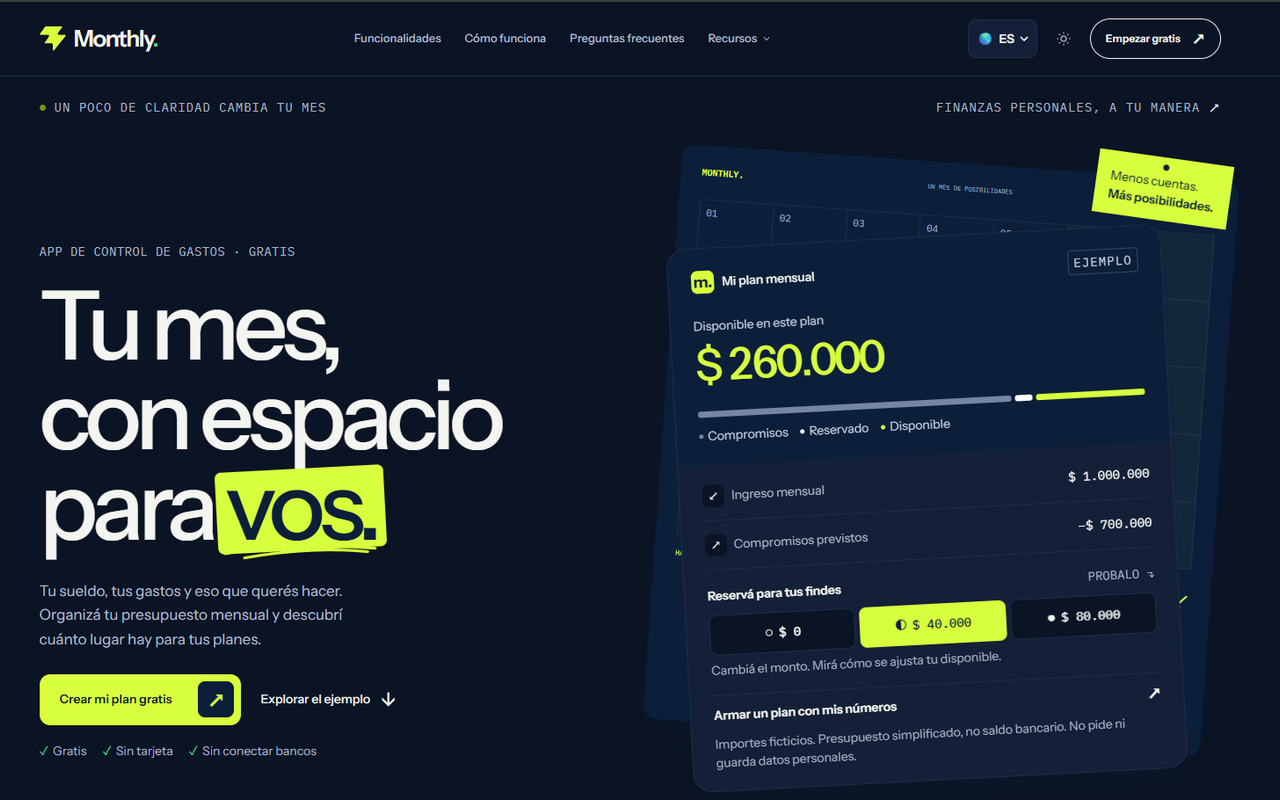
Monthly accounts for every dollar in three layers instead of thirty lines. Fixed expenses and instalments (rent, loan payments, subscriptions, insurance) are listed individually because they do not move. The weekend reserve is money you decide up front to spend on going out. Savings goals live under Net worth, Goals, with a target, a date and the contributions you log. What remains is free money: unassigned on purpose, and visible.
That last part is the philosophical difference. A strict zero-based budget would split the remainder into groceries, gas, household and dining. Monthly leaves it as one number and lets you spend it with judgment, because the variable lines are exactly the ones most people stop updating. You still know where every dollar went, since each expense you log reduces the figure and stays in the month’s history with its category.
2. YNAB: the complete method, with the most upkeep
A favor
- The most developed version of the method, with published guides
- Subscription can be shared with up to six people in total, per its pricing page
- 34-day free trial with no card required when signing up directly
En contra
- $109 a year or $14.99 a month
- Every transaction belongs to a category you maintain
- The learning curve is real for first-time budgeters
Best for: people who enjoy the process and will review categories several times a week.
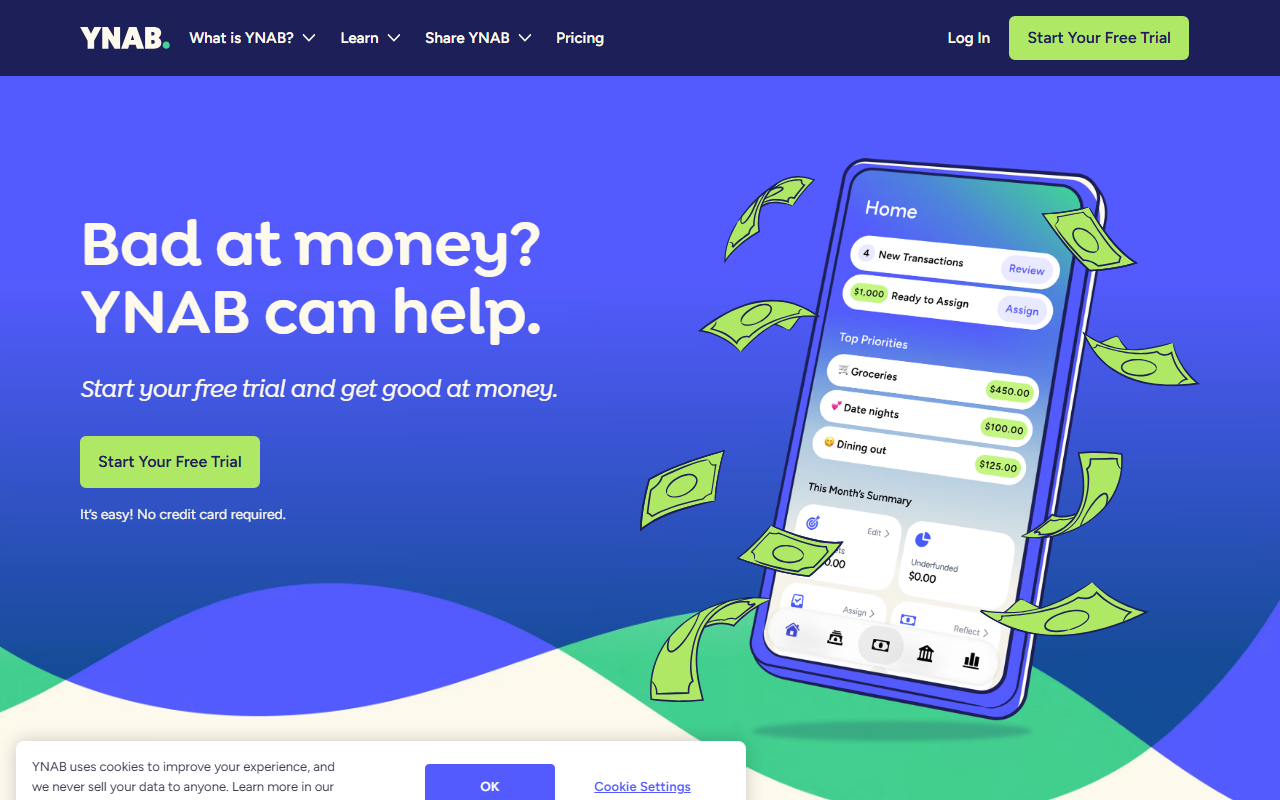
YNAB’s pricing page lists $109 billed yearly or $14.99 monthly, a 34-day trial, and sharing with partners or family for up to six people under one subscription. Its method is the reference point for this whole category. If you have the discipline for it, nothing else on this list is as thorough. If you have abandoned it before, the method was probably not the problem; the line count was.
3. EveryDollar: free zero-based budgeting, with paid extras
A favor
- Free version with no time limit, unlimited categories and manual entry
- Sinking funds, split transactions and bill due dates in the free tier
- Built explicitly around planning every dollar before the month starts
En contra
- Bank connection, payday planning and the debt payoff tracker are Premium
- Premium costs $79.99 a year or $17.99 a month
- Unlimited categories invite the line sprawl that sinks budgets
Best for: people who want the zero-based rule for free.
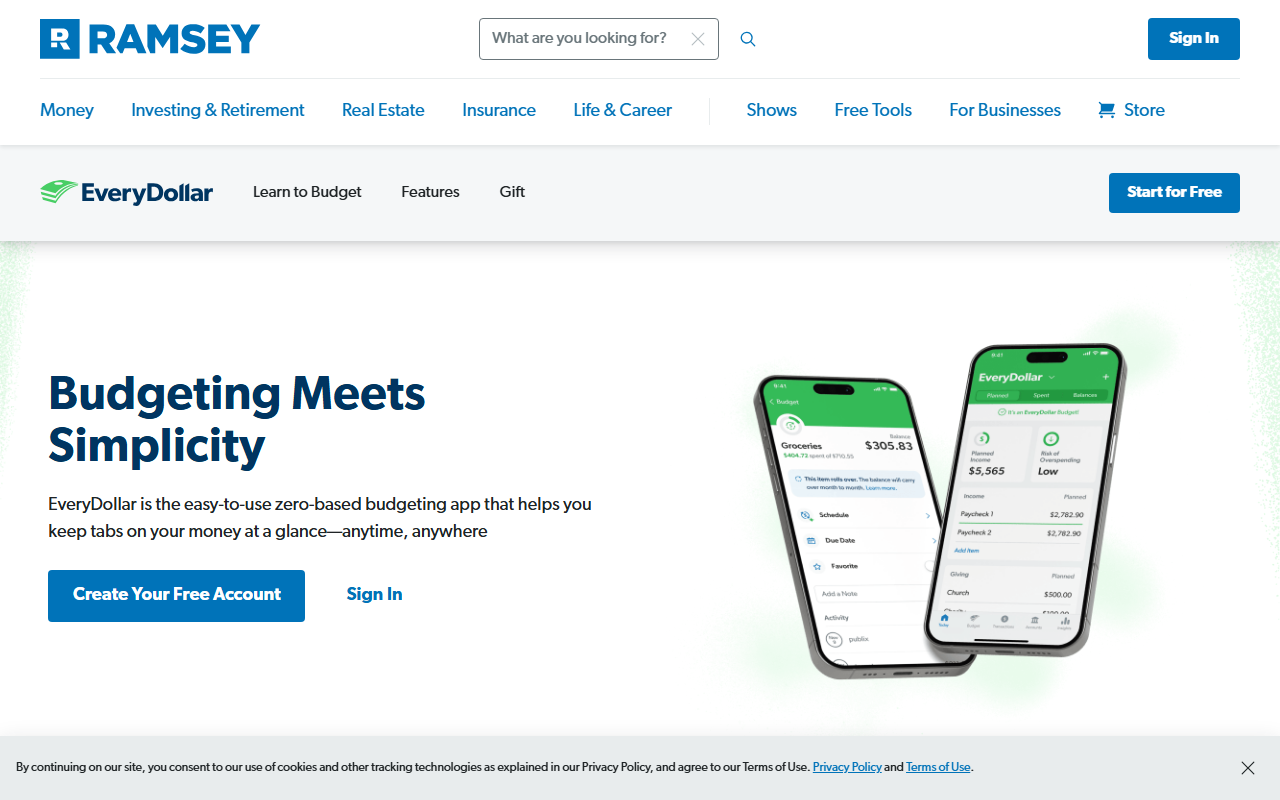
Ramsey Solutions’ EveryDollar page calls it a zero-based budgeting app where you plan every dollar before the month begins. The free tier is generous for manual budgeters. The risk is the same one this article is about: unlimited categories are a feature until you have to update all of them.
4. Tiller: build your own zero-based sheet, with bank feeds
A favor
- Pulls bank transactions into a spreadsheet automatically
- Foundation template plus free community templates
- You control every formula and category
En contra
- $99 a year after a 30-day trial
- Requires linking bank accounts
- You build and maintain the zero-based logic yourself
Best for: spreadsheet people who want the data to arrive on its own.
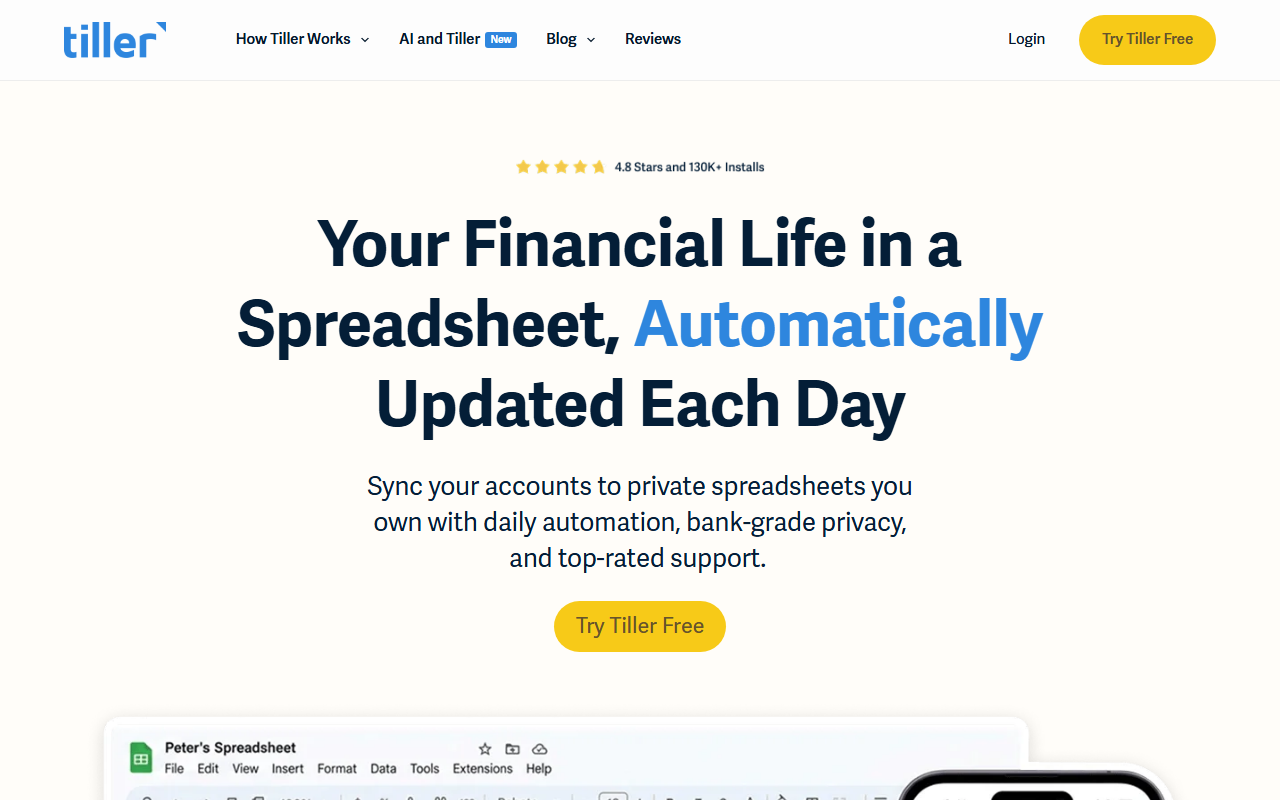
Tiller’s pricing page lists a 30-day trial and $99 a year, with automatic bank connections and templates. It does not enforce zero-based budgeting; it gives you the raw transactions and a sheet to do it in. That is the right trade for someone who already knows the formulas and wants to stop typing transactions.
5. Goodbudget: zero-based logic as envelopes
A favor
- Free plan with 10 regular and 10 additional envelopes, 1 account, 2 devices
- Debt tracking included on both plans
- Envelopes make the 'every dollar has a place' idea visual
En contra
- Premium is $10 a month or $80 a year for unlimited envelopes and bank sync
- Filling envelopes each period is a ritual you must keep
- The free plan's 1 year of history is short
Best for: people who think in envelopes rather than ledger lines.
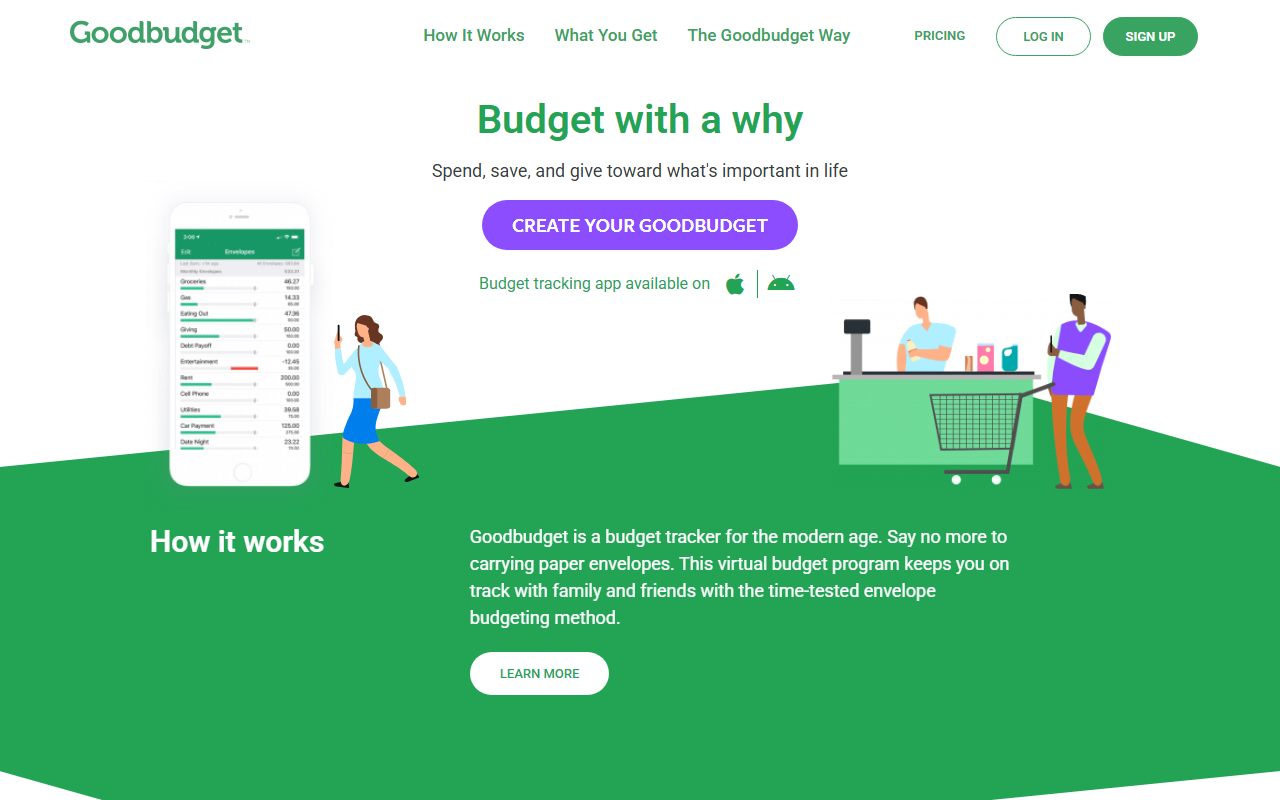
Goodbudget’s sign-up page lists the free and Premium limits above. The free plan’s cap of twenty envelopes is, oddly, a feature for this reader: it forces you to merge lines. If you want more on this style, our envelope budgeting apps comparison goes deeper.
A worked example: the same paycheck, 28 lines versus 9
The figures are illustrative. Take-home pay is $4,200 a month.
The zero-based version lists 28 lines: rent $1,450, car payment $310, car insurance $140, phone $65, internet $60, streaming $32, gym $40, student loan $220, groceries $520, gas $160, household $60, toiletries $35, restaurants $180, coffee $45, clothing $70, gifts $40, hobbies $50, personal care $40, pet $55, medical copays $40, car registration fund $25, holiday fund $60, emergency fund $200, vacation fund $100, subscriptions misc $20, haircuts $30, donations $50, miscellaneous $103. Total: $4,200. Plan equals zero.
The Monthly version keeps the commitments that do not move as fixed expenses: rent, car payment, car insurance, phone, internet, streaming, gym and student loan come to $2,317. Planned savings as fixed lines (emergency $200, holiday $60, car registration $25, vacation $100) add $385. A weekend reserve covers restaurants, coffee and hobbies: $275. That is $2,977 committed across 13 entries, leaving $1,223 of free money for groceries, gas, household and everything else.
| Zero-based | Monthly | |
|---|---|---|
| Lines you maintain | 28 | 13 entries, 1 remainder |
| Lines that change weekly | about 15 | 1 (free money) |
| Dollars unaccounted for | $0 | $0 |
Both plans account for all $4,200. The difference is that in the second one, a $40 overrun at the grocery store does not require moving money from “coffee” to “groceries.” It simply lowers one number you are already watching. You lose some detail; you gain a plan you might still be following in March.
Which app for which kind of budgeter
| If you… | Start with |
|---|---|
| Quit zero-based budgets because of upkeep | Monthly |
| Love the method and review often | YNAB |
| Want zero-based for $0 | EveryDollar free |
| Already live in spreadsheets | Tiller |
| Think in envelopes and share a household | Goodbudget |
How to keep any zero-based budget alive
Cap the variable lines. List fixed bills individually, but keep variable spending to four or five broad lines. Our categories checklist helps you find the fixed ones you might be missing.
Turn sinking funds into fixed lines. Car registration and holidays are certain; treat their monthly share like a bill.
Review once a week, not after every purchase. A weekly ten-minute check catches drift without making the budget a chore.
Judge the plan by March, not by day five. Any budget looks good on the first of the month.
The bottom line
Zero-based budgeting is a goal, not a line count. If you want every dollar to have a job and you have the time to manage thirty jobs, YNAB and EveryDollar are built for you. If you want the same accountability with fewer moving parts, the Monthly method lists what is fixed and leaves one honest remainder. Start with this month’s income and fixed bills in Monthly and see what your free money really is → This article is general information, not personalized financial advice.